
Most message brokers deliver at least once, so your consumer will eventually see the same message twice. The Inbox pattern writes every incoming message to an inbox table keyed by message id, so duplicates are ignored on insert. A separate processor picks up the unprocessed rows in batches and gives you control over retries.
The new ReSharper extension brings 20 years of C# expertise to VS Code and Cursor. Try it today and start shipping production-ready code with confidence!
Add Working AI UI Without Starting From Scratch
Speed up the development of AI apps and start building AI UI.
Implement smart featured components into your apps and projects right away by
starting a free trial for the component library of your choice.
Try now!
The Outbox pattern gets a lot of attention, and rightly so. But what about the consumer side?
Your publisher reliably sends a message. The broker delivers it. Your consumer processes it. Then something goes wrong. A timeout, a crash, a network blip. The broker redelivers the same message. Your consumer runs the same logic twice. This is a problem.
The Inbox pattern is the counterpart to the Outbox. The Outbox ensures reliable publishing. The Inbox ensures reliable consumption. Each incoming message is processed exactly once, even when the broker retries.
Here's how to implement it.
Why You Need an Inbox
Most message brokers provide at-least-once delivery. The broker guarantees every message will be delivered, but it doesn't guarantee each message arrives only once.
Here's a common failure path:
- The broker delivers a message to your consumer
- Your consumer processes it successfully
- Before the ACK reaches the broker, the connection drops
- The broker assumes the message was lost and redelivers it
- Your consumer processes the same message twice
You could make each handler idempotent. That works, but it means every consumer needs to check a deduplication table before doing any work. The Inbox centralizes this into a single mechanism at the infrastructure level. I will talk more about the trade-offs between the Inbox and the Idempotent Consumer at the end.
The idea:
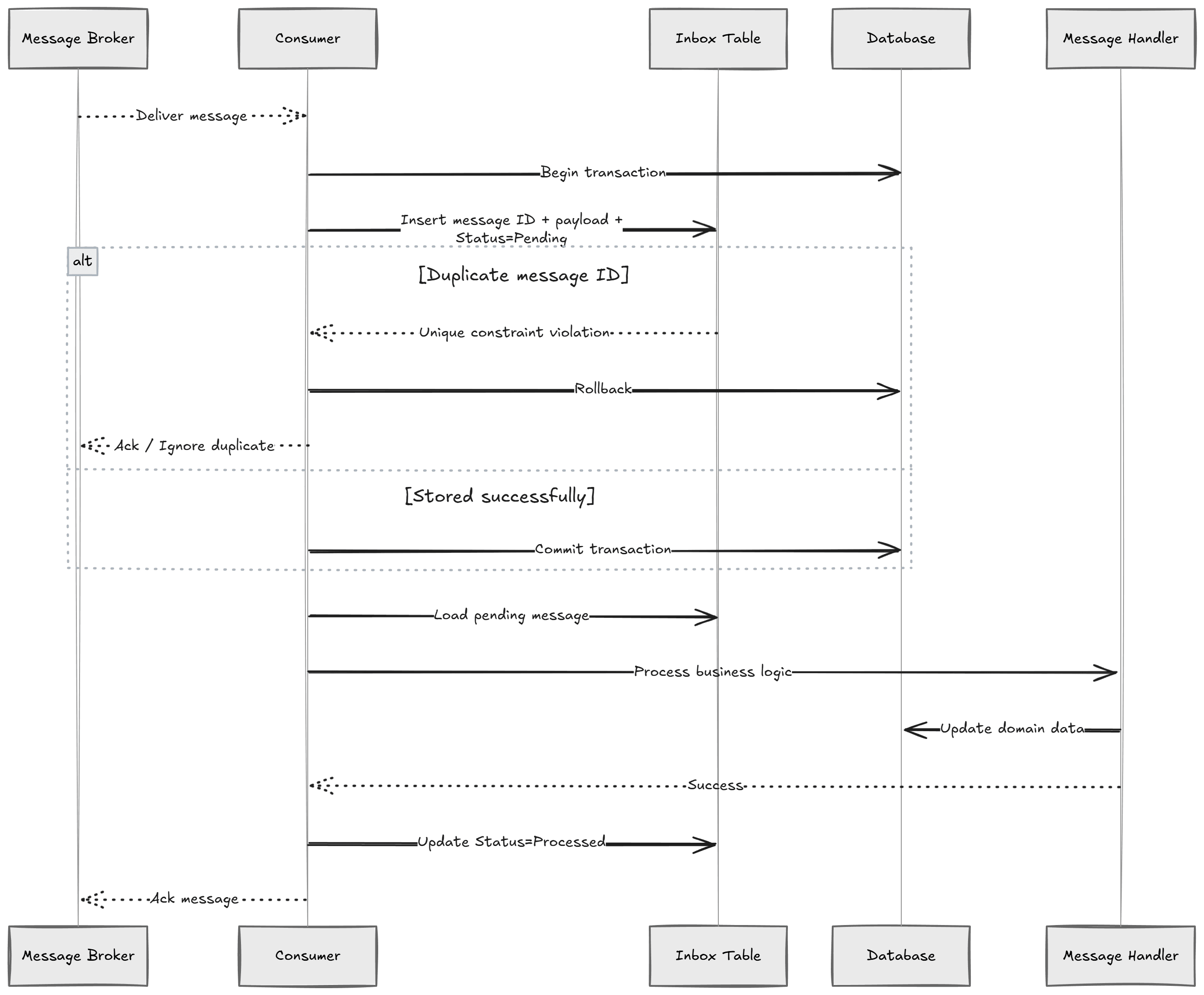
- A message arrives from the broker
- Instead of processing it immediately, write it to an inbox table
- If the message already exists (duplicate), the write is silently ignored
- A background process reads unprocessed messages and handles them
This decouples reception from processing. The consumer becomes a thin persistence layer that can't produce duplicates.
Inbox Database Schema
The inbox_messages table stores every incoming message:
CREATE TABLE IF NOT EXISTS inbox_messages (
    id UUID PRIMARY KEY,
    type VARCHAR(255) NOT NULL,
    content JSONB NOT NULL,
    received_on_utc TIMESTAMP WITH TIME ZONE NOT NULL,
    processed_on_utc TIMESTAMP WITH TIME ZONE NULL,
    error TEXT NULL
);

CREATE INDEX IF NOT EXISTS idx_inbox_messages_unprocessed
ON public.inbox_messages (received_on_utc, processed_on_utc)
INCLUDE (id, type, content)
WHERE processed_on_utc IS NULL;
The structure mirrors the Outbox pattern's outbox_messages table.
The id enables idempotent inserts via ON CONFLICT DO NOTHING.
The filtered index keeps the index small since processed messages drop out automatically.
Messages between services use a shared IntegrationEvent base record:
public abstract record IntegrationEvent(Guid MessageId);

public sealed record OrderCreatedIntegrationEvent(Guid OrderId)
    : IntegrationEvent(Guid.CreateVersion7());
Inbox Consumer
The consumer is a MassTransit IConsumer<T>.
Instead of processing the message, it writes it to the inbox table and returns.
That's it.
We can make this generic so it works for any integration event:
internal sealed class InboxConsumer<T>(NpgsqlDataSource dataSource)
    : IConsumer<T> where T : IntegrationEvent
{
    public async Task Consume(ConsumeContext<T> context)
    {
        await using var connection = await dataSource.OpenConnectionAsync(
            context.CancellationToken);

        const string sql =
            @"""
            INSERT INTO public.inbox_messages (id, type, content, received_on_utc)
            VALUES (@Id, @Type, @Content::jsonb, @ReceivedOnUtc)
            ON CONFLICT (id) DO NOTHING;
            """;

        await connection.ExecuteAsync(sql, new
        {
            Id = context.Message.MessageId,
            Type = typeof(T).FullName,
            Content = JsonSerializer.Serialize(context.Message),
            ReceivedOnUtc = DateTime.UtcNow
        });
    }
}
ON CONFLICT (id) DO NOTHING is doing the heavy lifting.
If the broker delivers the same message twice, the second insert is silently ignored.
Crash after insert but before ACK? The next delivery is safely deduplicated.
Inbox Processor
The processor runs in a background service or a scheduled job, fetching unprocessed messages in batches and dispatching them for handling.
internal sealed class InboxProcessor(
    NpgsqlDataSource dataSource,
    IEventDispatcher eventDispatcher,
    ILogger<InboxProcessor> logger)
{
    private const int BatchSize = 1000;

    public async Task<int> Execute(CancellationToken cancellationToken = default)
    {
        await using var connection =
            await dataSource.OpenConnectionAsync(cancellationToken);
        await using var transaction =
            await connection.BeginTransactionAsync(cancellationToken);

        var messages = (await connection.QueryAsync<InboxMessage>(
            @"""
            SELECT id AS Id, type AS Type, content AS Content
            FROM inbox_messages
            WHERE processed_on_utc IS NULL
            ORDER BY received_on_utc
            LIMIT @BatchSize
            FOR UPDATE SKIP LOCKED
            """,
            new { BatchSize },
            transaction: transaction)).AsList();

        var processedAt = DateTime.UtcNow;
        var results = new List<(Guid Id, DateTime ProcessedAt, string? Error)>(
            messages.Count);

        foreach (var message in messages)
        {
            try
            {
                var messageType = Type.GetType(message.Type)!;
                var deserialized = JsonSerializer.Deserialize(
                    message.Content, messageType)!;

                await eventDispatcher.DispatchAsync(deserialized, cancellationToken);

                results.Add((message.Id, processedAt, null));
            }
            catch (Exception ex)
            {
                logger.LogError(ex, "Failed to process inbox message {Id}", message.Id);
                results.Add((message.Id, processedAt, ex.ToString()));
            }
        }

        if (results.Count > 0)
        {
            await connection.ExecuteAsync(
                @"""
                UPDATE inbox_messages
                SET processed_on_utc = v.processed_on_utc,
                    error = v.error
                FROM UNNEST(@Ids, @ProcessedAts, @Errors)
                    AS v(id, processed_on_utc, error)
                WHERE inbox_messages.id = v.id
                """,
                new
                {
                    Ids = results.Select(r => r.Id).ToArray(),
                    ProcessedAts = results.Select(r => r.ProcessedAt).ToArray(),
                    Errors = results.Select(r => r.Error).ToArray()
                },
                transaction: transaction);
        }

        await transaction.CommitAsync(cancellationToken);

        return messages.Count;
    }
}
FOR UPDATE SKIP LOCKEDlets multiple processor instances run concurrently without contention. I covered this in scaling the Outbox pattern.- Batch update with
UNNESTwrites all results in a single round-trip using the same bulk update approach. - Error capture: failed messages get marked with the exception so they don't block the queue.
If the process crashes mid-batch, the transaction rolls back and messages get picked up on the next run.
Things to Watch Out For
Table growth. The inbox table grows indefinitely. Delete processed messages after a retention period, or partition by time range and drop old partitions. You can also archive them to another table if you need to keep a history.
Poison messages. If a message consistently fails, it gets marked with an error each time. Consider a max retry count. After N failures, dead-letter it and alert.
Ordering.
ORDER BY received_on_utc gives you rough arrival-time ordering.
But with SKIP LOCKED and multiple processors, strict ordering is not guaranteed.
If you need per-aggregate ordering,
you'll need additional coordination.
Monitoring.
Track the lag between received_on_utc and processed_on_utc.
If this gap grows, increase the batch size, decrease the polling interval,
or scale out more processor instances.
Inbox vs. Idempotent Consumer
Both the Inbox and the Idempotent Consumer prevent duplicate processing. The difference is when processing happens and who controls retries.
The Idempotent Consumer processes messages inline. It checks a deduplication table, does the work, and records the dedup entry in the same transaction. If processing fails, the transaction rolls back, no dedup record is written, and the broker redelivers the message on its own schedule. You don't control retry timing or backoff.
The Inbox separates reception from processing.
The consumer writes the message and ACKs immediately. The broker is done.
If the processor fails, it records the error and moves on.
Retries are your responsibility: reset processed_on_utc to NULL for messages under a retry threshold,
or run a separate loop that picks up failed messages after a delay.
Use the Idempotent Consumer when your side effects are transactional
and broker-managed retries are good enough.
Use the Inbox when you need batching, custom retry policies,
or horizontal scaling via FOR UPDATE SKIP LOCKED.
Summary
The Inbox pattern is the consumer-side counterpart to the Outbox pattern.
ON CONFLICT DO NOTHINGmakes consumer inserts idempotent- Separation of reception and processing gives you independent retry control
FOR UPDATE SKIP LOCKEDenables horizontal scaling of the processor- Batch updates with
UNNESTminimize database round-trips
If you want to see how I build event-driven systems with these patterns, check out Modular Monolith Architecture.
Thanks for reading.
And stay awesome!
Frequently Asked Questions
What is the inbox pattern?
The inbox pattern is the consumer-side counterpart to the outbox pattern. Instead of processing an incoming message immediately, the consumer writes it to an inbox table, duplicates are silently ignored, and a background process handles unprocessed messages. Each message is processed exactly once even when the broker retries.
Why do message brokers deliver duplicate messages?
Most brokers provide at-least-once delivery. If a consumer processes a message but the connection drops before the ACK reaches the broker, the broker assumes the message was lost and redelivers it, so the consumer runs the same logic twice.
How does the inbox pattern deduplicate messages?
Each message carries a unique id that becomes the primary key of the inbox table, and the consumer inserts with ON CONFLICT (id) DO NOTHING. If the broker delivers the same message twice, the second INSERT is silently ignored.
How do you scale the inbox processor?
Fetch unprocessed messages with FOR UPDATE SKIP LOCKED so multiple processor instances run concurrently without contention, and write results back in one round-trip using a batched UPDATE with UNNEST. If the process crashes mid-batch, the transaction rolls back and messages are picked up on the next run.
Should I use the inbox pattern or an idempotent consumer?
Use the idempotent consumer when your side effects are transactional and broker-managed retries are good enough; it processes messages inline and the broker controls retry timing. Use the inbox when you need batching, custom retry policies, or horizontal scaling with FOR UPDATE SKIP LOCKED.
Does the inbox pattern preserve message ordering?
Not strictly. Ordering by received time gives rough arrival-time order, but with SKIP LOCKED and multiple processors strict ordering is not guaranteed, so per-aggregate ordering needs additional coordination. Also plan for table growth with a retention period and dead-letter poison messages after repeated failures.


