

The test pyramid assumes integration tests are slow and expensive, which stopped being true once Testcontainers and the Aspire test host arrived. I ship 15-25% unit tests on pure domain logic, 60-70% integration tests against real infrastructure, and under 10% end-to-end tests for business-critical flows.
AI-assisted development often falters when agents operate in a vacuum, blind to the unspoken rules and architectural nuances unique to a specific codebase. By grounding AI agents in repo-aware dynamic context, Sonar's Context Augmentation reduces iterative rework with first-pass precision, ensuring every AI-generated line respects the architectural and security standards of your project. Check it out.
exe.dev reimagines cloud dev with instant persistent VMs - SSH in, build anything, deploy without touching infrastructure. Learn more here.
I'll be honest. For years, my projects didn't look like the test pyramid.
A wide base of unit tests, a narrow middle of integration tests, a tiny sliver of end-to-end tests at the top. I'd nod along in conference talks, then go back to my own code and do something different.
A thin layer of unit tests for the things worth unit-testing. A thick slab of integration tests against real PostgreSQL, real RabbitMQ, real HTTP. A handful of end-to-end tests for the flows that would get me fired if they broke.
And I shipped with more confidence that way, not less. Here's why, and here's the shape I actually use.
Where the Pyramid Comes From
The pyramid was popularized by Mike Cohn in 2009, when integration tests meant a shared database server, flaky CI, and 20-minute builds. Unit tests with mocks were the pragmatic compromise.
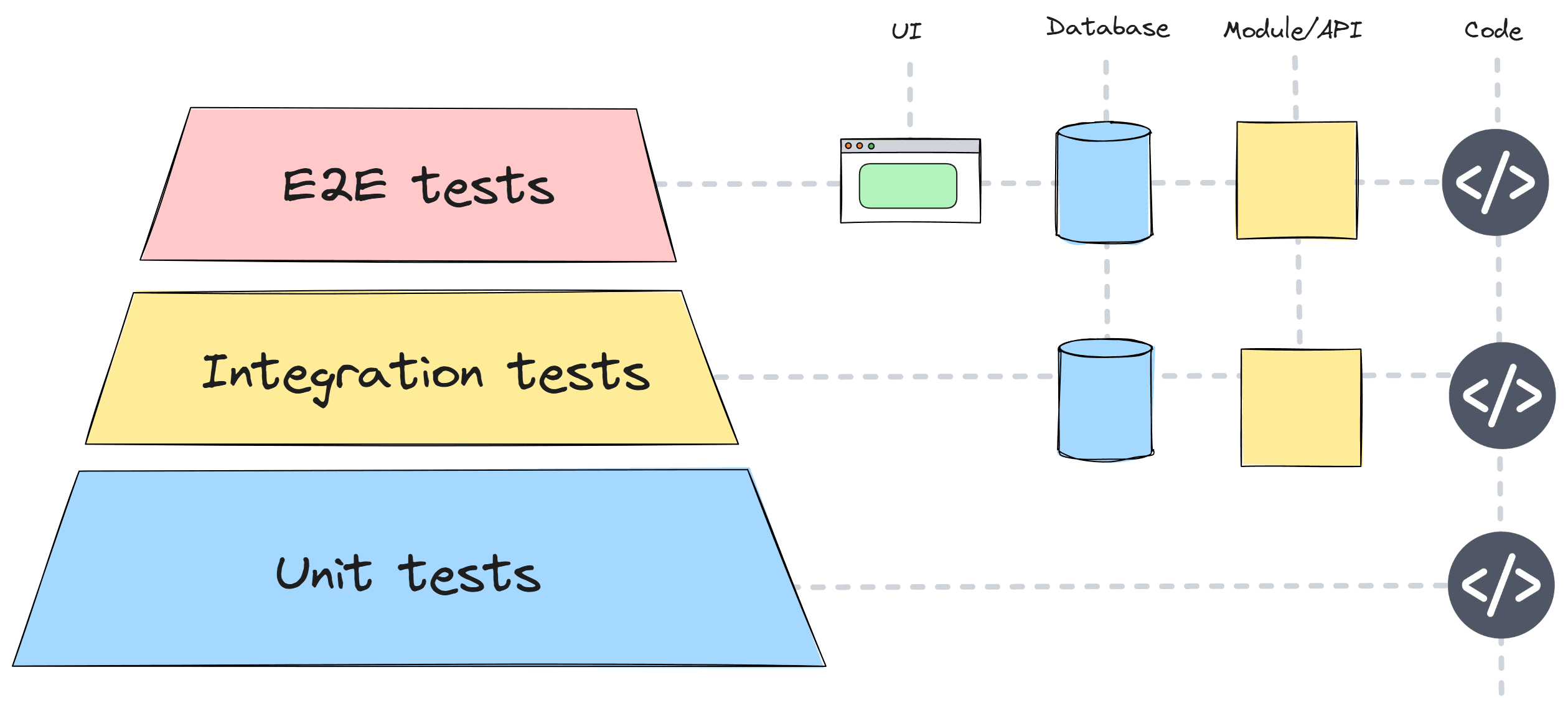
That world is gone. With Testcontainers, I can spin up PostgreSQL, Redis, and RabbitMQ in a fresh container per test class in a few seconds. The Aspire test host takes this further by wiring up your entire application graph. The argument that real dependencies are too expensive mostly doesn't apply anymore.
But the advice didn't update.
The Bug That Convinced Me
A few years ago I had a service with 94% unit test coverage. All green.
A user reported that deleting an account didn't actually delete their data. The bug was three lines long:
public async Task Handle(DeleteAccountCommand command, CancellationToken ct)
{
    var account = await _repository.GetByIdAsync(command.AccountId, ct);
    account.MarkAsDeleted();
    // Missing: await _unitOfWork.SaveChangesAsync(ct);
}
The honest diagnosis is that the test for this case was never written.
You can absolutely verify SaveChangesAsync was called with a mock.
But in a codebase where that test is one of hundreds of handler tests, each with its own mock setup and its own verification list, it's the kind of assertion people forget.
I forgot.
A single integration test against a real database would have caught it without anyone having to remember. That's the point: the fewer invariants your test style forces you to remember, the fewer bugs slip through.
That was the last week I took the test pyramid seriously.
What Unit Tests Are Actually Good At
I still write unit tests. Just not many.
They earn their keep when the logic is non-trivial, pure (no I/O, no time, no randomness), and hard to exercise end-to-end. That's a specific set of code: value objects and rich domain models, pricing and tax calculations, parsers, mappers, serializers.
Notice what's not on that list: application services, handlers, controllers, repositories, infrastructure. Those live at the seams, and the seams are where real bugs live.
What I Actually Write Instead
Here's the shape I've settled on for a typical .NET service or modular monolith.
Layer 1: A thin base of unit tests
Maybe 15-25% of the test count. All domain logic. No mocks of collaborators. If a unit test needs a mock, I usually pull the test up to the integration layer instead.
[Fact]
public void Confirm_WhenPending_TransitionsToConfirmed()
{
    var order = Order.Create(CustomerId.New(), Money.Usd(100));

    order.Confirm();

    order.Status.Should().Be(OrderStatus.Confirmed);
    order.DomainEvents.Should().ContainSingle(e => e is OrderConfirmedEvent);
}
No container or mocks. Microseconds per test. This is what unit tests are for.
Layer 2: A thick middle of integration tests
The majority. Maybe 60-70% of the suite. Every command and query handler, every HTTP endpoint, every message consumer gets a test that runs against real infrastructure inside Testcontainers. In a modular monolith, this is where you verify that modules talk to each other correctly across their public APIs.
public class DeleteAccountTests(IntegrationTestWebAppFactory factory)
    : BaseIntegrationTest(factory)
{
    [Fact]
    public async Task DeleteAccount_WhenAccountExists_MarksAccountAsDeleted()
    {
        var account = await CreateAccountAsync();

        var response = await HttpClient.DeleteAsync($"/accounts/{account.Id}");

        response.StatusCode.Should().Be(HttpStatusCode.NoContent);

        var stored = await DbContext.Accounts
            .IgnoreQueryFilters()
            .SingleAsync(a => a.Id == account.Id);

        stored.IsDeleted.Should().BeTrue();
    }
}
That test exercises the HTTP layer, routing, model binding, authorization, the handler, the unit of work, EF Core, and PostgreSQL.
It proves the thing you actually care about: when I call this endpoint, the row changes.
And it does it without anyone having to remember to assert SaveChangesAsync was called.
Layer 3: A small cap of end-to-end tests
Under 10%. Only the flows where a silent failure would be a commercial or compliance problem. Signup, payment, refund, password reset, two-factor enrollment. They're slow and occasionally flaky, but they catch the one failure mode everything else misses: the system as a whole still works.
Layer 0: Architecture and contract tests
Often forgotten, but they're part of the suite. Architecture tests enforce layering and module boundaries. Contract tests verify that message schemas and API shapes don't drift. They run in milliseconds and catch the "six months from now, someone will break this without realizing" kind of bug.
The shape that comes out of this is closer to Kent C. Dodds' testing trophy than a pyramid. The fat middle is deliberate. That's where my confidence comes from.
The Usual Objections
"Integration tests are slow." My typical integration suite runs in 2-4 minutes in CI with Testcontainers reuse and test-class parallelization. Slower than unit tests, yes. Faster than finding the bug in production.
"Mocks are fine if you're disciplined." Maybe. But every large codebase I've audited that leaned heavily on mocks had the same pathology: tests that pass after a refactor even though the refactor broke production. That's not discipline failing. That's the tool being pointed in the wrong direction.
Summary
The test pyramid was good advice for 2009 infrastructure and poor advice for 2026 infrastructure. Testcontainers and Aspire changed the economics, and the fastest feedback loop that still tells you the truth is now an integration test against real dependencies. Unit tests still belong on pure domain logic. Everything at the seams belongs in the integration layer.
If you want to see how I wire this into a real system, with the integration test harness, module boundaries, and the full Clean Architecture setup, check out Pragmatic Clean Architecture. It's the same approach I use on my own projects.
Thanks for reading.
And stay awesome!
Frequently Asked Questions
Is the test pyramid still relevant?
The pyramid was popularized by Mike Cohn in 2009, when integration tests meant a shared database server, flaky CI, and 20-minute builds. Testcontainers and the Aspire test host changed those economics, so the argument that real dependencies are too expensive mostly no longer applies.
What should I use instead of the test pyramid?
A shape closer to the testing trophy: a thin base of unit tests (15-25%) for pure domain logic, a thick middle of integration tests (60-70%) against real infrastructure, under 10% end-to-end tests for business-critical flows, plus architecture and contract tests underneath.
What are unit tests actually good for?
Logic that is non-trivial, pure (no I/O, time, or randomness), and hard to exercise end-to-end: value objects, rich domain models, pricing and tax calculations, parsers, mappers, and serializers. Handlers, controllers, repositories, and infrastructure live at the seams and belong in integration tests.
Are integration tests too slow to be the majority of a test suite?
Not anymore. Testcontainers can spin up PostgreSQL, Redis, and RabbitMQ in a fresh container per test class in a few seconds, and a typical integration suite runs in 2-4 minutes in CI with container reuse and test-class parallelization.
What's wrong with mock-heavy unit tests?
Mock-based tests make you remember every assertion, like verifying a save was called, and forgotten assertions let bugs slip through even 94% coverage. Mock-heavy codebases also show tests that keep passing after a refactor even though the refactor broke production.
When are end-to-end tests worth writing?
Keep them under 10% of the suite and reserve them for flows where a silent failure is a commercial or compliance problem: signup, payment, refund, password reset, two-factor enrollment. They are slow and occasionally flaky, but they prove the system as a whole still works.